PuLP to XGBoost Migration

I've been working on corrugate paper scheduling for production for a while, The techniques I use is SAT Solver, CBC Solver, Genetic Algorithms and Heuristic Selection. Because of how complex the rules for planning is I thought that this data is impossible to train a model, but recently I enroll in Data Science course and have a knowledge to determine features and target of data. I use that knowledge immediately, And it came to me that the results I got from my optimization program is the target. So I start working on it right away. I query a year worth of orders from my company database, and feed it to my program. Then I use the output I got, do some feature selection split in to train and test dataset. And use XGBoost with Opuna for hyperparameters optimization with Kfold as cross validation and training for a day.
# Defining the objective function
from sklearn.model_selection import KFold

def objective(trial):
    param = {
        'max_depth': trial.suggest_int('max_depth', 3, 10),
        'learning_rate': trial.suggest_float('learning_rate', 0.01, 0.2),
        'n_estimators': trial.suggest_int('n_estimators', 100, 1000),
        'subsample': trial.suggest_float('subsample', 0.5, 1.0),
        'colsample_bytree': trial.suggest_float('colsample_bytree', 0.5, 1.0),
        'min_child_weight': trial.suggest_int('min_child_weight', 1, 10),
        'gamma': trial.suggest_float('gamma', 0, 5),
        'tree_method': 'hist',  # Use 'hist' for faster training, supports GPU
        'device': 'cuda',  # Specify GPU usage
        'objective': 'multi:softmax',
        'eval_metric': 'auc'
    }

    # Initialize lists to store scores for each fold
    scores = []
    kf = KFold(n_splits=3, shuffle=True, random_state=42)

    for train_idx, val_idx in kf.split(X_train.get()):
        # Split data into training and validation sets for the current fold
        X_train_fold = X_train.get()[train_idx]
        y_train_fold = y_train.get()[train_idx]
        X_val_fold = X_train.get()[val_idx]
        y_val_fold = y_train.get()[val_idx]

        # Initialize the model
        model = XGBClassifier(**param, early_stopping_rounds=50)

        # Fit the model with early stopping
        model.fit(
            X_train_fold,
            y_train_fold,
            eval_set=[(X_val_fold, y_val_fold)],
            verbose=False
        )

        # Evaluate on the validation set
        score = model.best_score  # Get the best AUC score from early stopping
        scores.append(score)

    # Return the mean score across folds
    return np.mean(scores)

def hpo(X_train, y_train):
  # Create and run the optimization process with 100 trials
  study = optuna.create_study(study_name="xgboost", direction='maximize')
  study.optimize(objective, n_trials=100, show_progress_bar=True, n_jobs=-1)

  # Retrieve the best parameter values
  best_params = study.best_params
  return best_params
I also use early-stop features from XGBoost with AUC curve as the evaluation metrics for faster and better model. And since my program have 2 output, roll_width and out. I had to train two models and use both model in concoction. The results is satisfactory as the calculation process is faster by 24.57%.
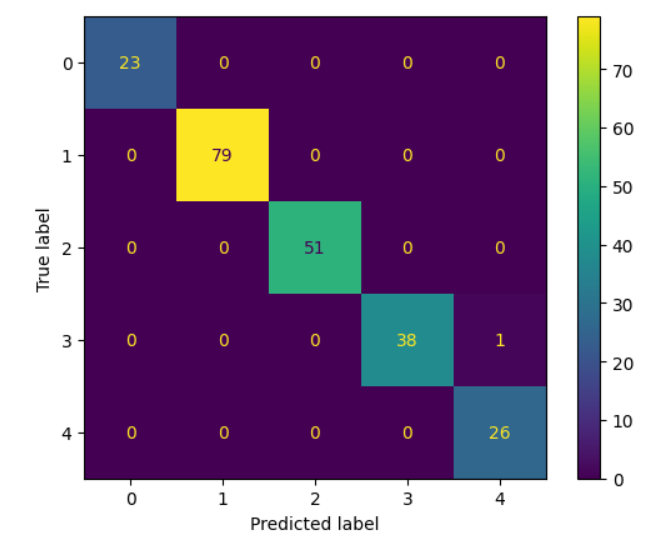
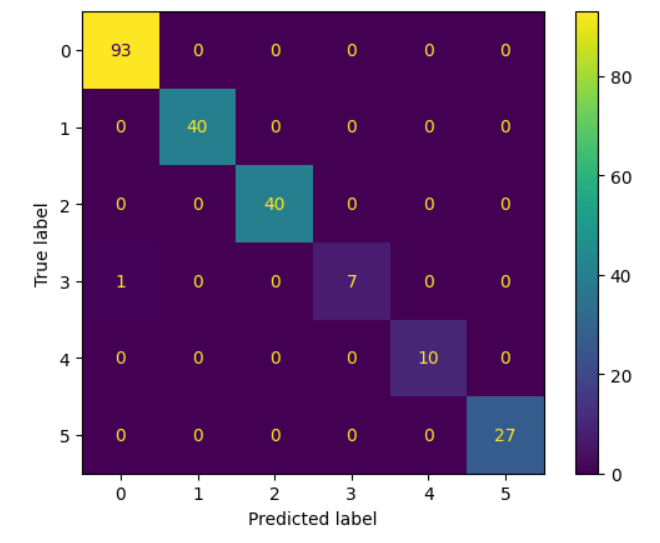
Confusion Matrix from Test set, from roughly around 1,000 of optimized orders.